
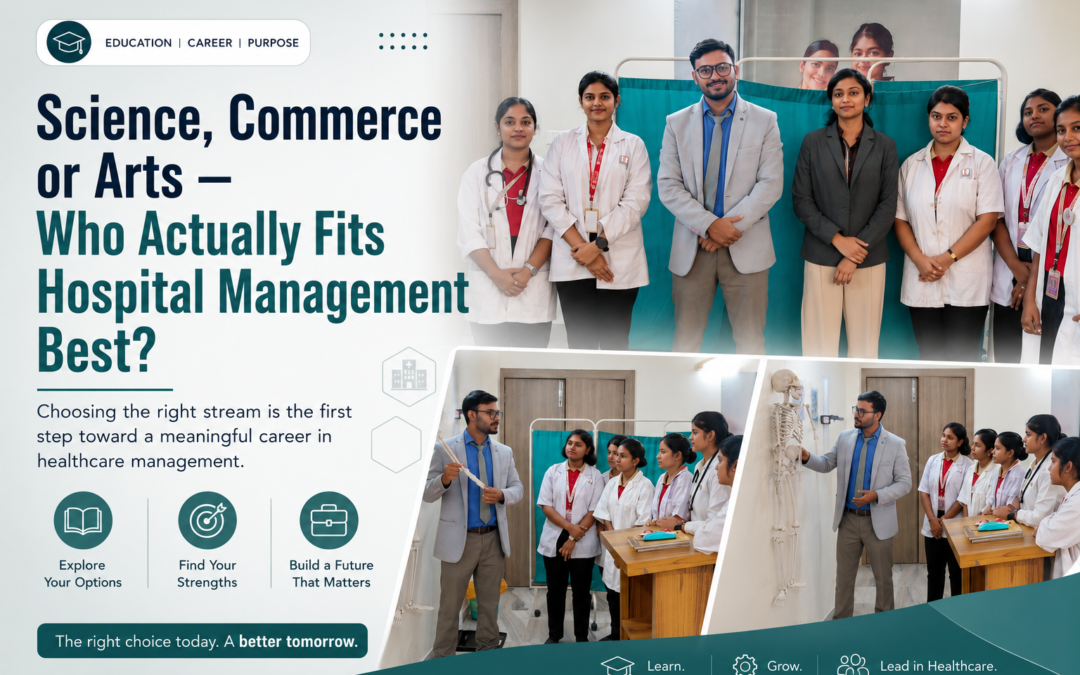
The healthcare industry is a rapidly growing industry in the modern world. Hospitals nowadays require not only medical professionals but also skilled managers and administrators who are capable of handling aspects such as administration, patient services, finance, communication, and operations. This is exactly where hospital management comes in. However, many students believe the myth that hospital management is a course meant only for Science students. In reality, Who Actually Fits Hospital Management Best, is a common misconception. This sector welcomes students from various academic backgrounds, including Science, Commerce, and Arts.
Many students believe in the myth that hospital management is a course which is only meant for Science students which is a common misconception. This sector welcomes students from various academic backgrounds, including Science, Commerce, and Arts, Hospital Management Is Not Limited to Science Students
Hospital management is a professional course that pairs healthcare knowledge alongside management and administrative skills. Students are educated in subjects such as hospital administration, communication, accounting, human resource management, healthcare laws, patient care services, and operational management.
The course emphasizes primarily on management and organizational skills thus students even from non-science backgrounds may also perform exceptionally well. A strong passion for healthcare services, leadership, teamwork, and communication is usually more desirable than having a Science background.
Thus, multiple colleges and universities across India provide hospital management programmes to applicants from all streams Science, Commerce, and Arts Students Are All Eligible
One of the biggest pros of hospital management programmes is its flexibility in terms of eligibility. Students who complete Higher secondary in either:
Science
Commerce
Arts/Humanities
can easily apply for undergraduate hospital management courses.
Most Programmes Require 45–50% in Higher secondary examinations
The eligibility criterias for the majority of undergraduate hospital management
programmes are both simple and student-friendly.
Usually , most colleges require:
- Completion of Class 12 from a authorised board
- Minimum marks of 45% to 50%
- Some institutions can have varying requirements depending on the reputation and admission process.
- However, students with average scores may still apply and secure admission.
- Some B.Sc.-Based Courses May Prefer Science Students
- Although most hospital management courses accept students from all streams, there are certain specialized courses which can prefer or require Science students.
For example:
- B.Sc. in Hospital Management
- B.Sc. in Healthcare Administration
- Courses involving medical laboratory or clinical subjects
- These courses can include subjects related to biology, anatomy, healthcare science, or medical technology. Because of which colleges may give preference to students from the Science stream.
On the other hand, degree programmes like:
- Bachelor of Hospital Management (BHM)
- Bachelor of Business Administration (BBA) in Hospital Management
- Diploma courses in Hospital Administration
Generally accept students from all streams without any restrictions.
Quick Comparison Table :
| Course Type | Science Students | Commerce Students | Arts Students | Minimum Marks |
|---|---|---|---|---|
| BBA in Hospital Management | ✅ Eligible | ✅ Eligible | ✅ Eligible | 45–50% |
| Bachelor of Hospital Management (BHM) | ✅ Eligible | ✅ Eligible | ✅ Eligible | 45–50% |
| Diploma in Hospital Administration | ✅ Eligible | ✅ Eligible | ✅ Eligible | 45–50% |
| B.Sc. in Hospital Management | ✅ Preferred | ⚠️ Sometimes Eligible | ⚠️ Sometimes Eligible | 50% or above |
| Healthcare Administration Courses | ✅ Eligible | ✅ Eligible | ✅ Eligible | Varies by college |
Career Opportunities:
After completing a hospital management programme, students can work in institutions like:
- Hospitals
- Clinics
- Healthcare organizations
- Insurance companies
- Medical tourism companies
- Pharmaceutical companies
- Health NGOs
- Common job roles include:
- Hospital Administrator
- Patient Service Executive
- Healthcare Manager
- Operations Coordinator
- Medical Office Manager
- Healthcare Consultant
- Healthcare information manager
- Quality assurance manager
With the rapid growth of healthcare services, the requirement for trained hospital management professionals continues to increase.
Science Students – Strong Clinical Foundation
Science students usually start with a natural advantage as they are familiar with concepts related to biology and medical terminology. This educational background aids them in understanding hospital systems, clinical departments, and healthcare procedures more easily and efficiently.
Thus, many Science students perform exceptionally in segments like hospital operations, clinical quality management, accreditation, and medical records administration. Their better understanding of healthcare environments permits them to coordinate and assist effectively with doctors and other medical staff.
On the other hand, Science students may lack and need to improve the knowledge regarding finance, budgeting, human resource management, and business strategy. Since hospitals are large organizations that utilise efficient administration, management skills are equally necessary.
Commerce Students – Natural Business Thinkers
Commerce students usually settle naturally in the business aspect of hospital management. Their familiarity regarding accounting, finance, economics, and organizational management provides them a strong start with administrative and financial roles.
They generally perform better in departments like hospital finance, billing, revenue management, insurance coordination, and healthcare supply chain management. Because modern hospitals function as complex business organizations, these skills are highly valued and sought after.
Needless to say , Commerce students might initially find difficulties dealing with medical terminology and clinical exposure. Working in a hospital environment requires utmost confidence during interactions with healthcare professionals and understanding basic medical procedures . Practical training and internships helps in overcoming these challenges.
Arts Students – The Hidden Advantage
Arts or humanities students are often underestimated in aspects of hospital management, but often possess some of the most important and valued qualities necessary in the healthcare segments. Strong and proficient communication skills, empathy, emotional intelligence, and a deeper understanding of human behavior are really valuable in hospitals.
Humanities students usually excel in patient relations, hospital human resources, public communication, healthcare NGOs, and policy-related roles. Their innate ability to handle people sensitively and communicate effectively can greatly enhance patient experiences and satisfaction.
To grow further in this field, Arts students will need to strengthen their grip on financial understanding, analytical abilities, and basic healthcare knowledge. With proper understanding and training, these segments can be developed successfully.
Who Fits Hospital Management Best?
The actual fact is that no singular stream is “best” for hospital management. Each and every stream brings their own individual strengths into this profession.
Science students usually contribute towards healthcare understanding. Commerce students bring in financial and business knowledge. Arts students provide communication and interpersonal skills.
The fact that matters most is not the stream itself, but the student’s ability to learn, adapt, and work across all departments. Hospital management professionals require proper understanding of healthcare systems whilst also handling administration, staff coordination, budgeting, and patient services.
This is exactly why practical training plays such a crucial role. Over time, students gradually learn about the areas that were not part of their respective academic background. Science students gradually develop management skills, Commerce students achieve clinical exposure, while Arts students know financial and healthcare fundamentals.
The Real Secret to Success
Success in the fields of hospital management relies much more on adaptability rather than academic background. The healthcare industry prioritize professionals who are capable of thinking practically, communicate efficiently, solve issues, work in coordination with different teams.
Cross-functional learning is the actual key. Students who are willing to gain knowledge beyond their individual streams usually become the most successful professionals in this industry.
All in all, hospital management is not just about studying Science, Commerce, or Arts. It is about effectively combining knowledge, leadership, communication, and practical experience to contribute towards the healthcare organizations.
Your stream might mark the starting point, but it does not decide the future.